Sunday, September 11, 2016

Monday, July 25, 2016
http://earthobservatory.nasa.gov/IOTD/view.php?id=81833
On April 9, 2013, the Moderate Resolution Imaging Spectroradiometers (MODIS) on NASA’s Aqua and Terrasatellites captured images of clouds developing over Sri Lanka in the span of a few hours around midday...........

Monday, July 18, 2016
Interactive Time-Lapse Map Shows How the U.S. Took More Than 1.5 Billion Acres From Native Americans

http://www.slate.com/blogs/the_vault/2014/06/17/interactive_map_loss_of_indian_land.html

The forgotten coup - how America and Britain crushed the government of their 'ally', Australia
23 October 2014

Across the political and media elite in Australia, a silence has descended on the memory of the great, reforming prime minister Gough Whitlam, who has died. His achievements are recognised, if grudgingly, his mistakes noted in false sorrow. But a critical reason for his extraordinary political demise will, they hope, be buried with him.
Australia briefly became an independent state during the Whitlam years, 1972-75. An American commentator wrote that no country had "reversed its posture in international affairs so totally without going through a domestic revolution". Whitlam ended his nation's colonial servility. He abolished Royal patronage, moved Australia towards the Non-Aligned Movement, supported "zones of peace" and opposed nuclear weapons testing.
Although not regarded as on the left of the Labor Party, Whitlam was a maverick social democrat of principle, pride and propriety. He believed that a foreign power should not control his country's resources and dictate its economic and foreign policies. He proposed to "buy back the farm". In drafting the first Aboriginal lands rights legislation, his government raised the ghost of the greatest land grab in human history, Britain's colonisation of Australia, and the question of who owned the island-continent's vast natural wealth.
http://johnpilger.com/articles/the-forgotten-coup-how-america-and-britain-crushed-the-government-of-their-ally-australia
GENOCIDE AND DENYING IT: WHY WE ARE NOT TAUGHT THAT THE NATIVES OF THE UNITED STATES AND CANADA WERE EXTERMINATED
Death Toll: 95,000,000 to 114,000,000
https://espressostalinist.com/genocide/native-american-genocide/
Sunday, July 17, 2016
https://www.youtube.com/watch?v=tnXjdv_GM9g
http://deadspin.com/the-story-behind-bob-beamons-miracle-jump-and-the-only-1736766124
This has happened in the 1968 Olympics in Mexico City
................ Officials had installed an electronic measuring device that ran
on a rail alongside the pit. The judges moved the optical sight to the point
where Beamon landed — out, farther, out some more – until it fell off the
far end of the rail. They hurried off to find a measuring tape.
Some 20 minutes passed as the officials checked and double-checked the
distance. Finally, three numbers were posted on the scoreboard: 8.90.
It was the distance of the jump in meters, and Beamon did not realize
what that was in feet and inches. Boston informed him it was beyond
29 feet–and Beamon collapsed onto the track..."

Great interviews of the 20th century
David Frost's interview with Richard Nixon broadcast in May 1977
https://www.theguardian.com/theguardian/2007/sep/07/greatinterviews1

Interviews - the PARIS REVIEW
William Faulkner, The Art of Fiction No. 12
Harold Pinter, The Art of Theater No. 3
Philip Roth, The Art of Fiction No. 84
Hilary Mantel, Art of Fiction No. 226
Alice Munro, The Art of Fiction No. 137
Joseph Heller, The Art of Fiction No. 51
Gore Vidal, The Art of Fiction No. 50
Interviews
Haruki Murakami, The Art of Fiction No. 182

Haruki Murakami is not only arguably the most experimental Japanese novelist to have been translated into English, he is also the most popular, with sales in the millions worldwide. His greatest novels inhabit the liminal zone between realism and fable, whodunit and science fiction: Hard-Boiled Wonderland and the End of the World, for example, features a protagonist who is literally of two minds, and The Wind-Up Bird Chronicle, perhaps his best-known work outside of Japan, begins prosaically—as a man’s search for his missing wife—then quietly mutates into the strangest hybrid narrative since Laurence Sterne’s Tristram Shandy. Murakami’s world is an allegorical one, constructed of familiar symbols—an empty well, an underground city—but the meaning of those symbols remains hermetic to the last. His debt to popular culture (and American pop culture, in particular) notwithstanding, it could be argued that no author’s body of work has ever been more private.
http://www.theparisreview.org/interviews/2/the-art-of-fiction-no-182-haruki-murakami
Saturday, July 16, 2016
Magna Carta – 800 years on
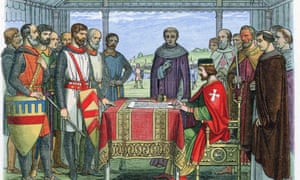
This year, 2015, is the 800th anniversary of Magna Carta. It was on 15 June 1215 that King John, in the meadow of Runnymede beside the Thames between Windsor and Staines, sealed (not signed) the document now known as the Magna Carta. Today, jets taking off from London Heathrow airport come up over Runnymede and then often turn to fly down its whole length before vanishing into the distance. Yet it is not difficult to imagine the scene, during those tense days in June 1215, when Magna Carta was being negotiated, the great pavilion of the king, like a circus top, towering over the smaller tents of barons and knights stretching out across the meadow........
https://www.theguardian.com/books/2015/jan/02/magna-carta-800th-anniversary-relevance-david-carpenter
The Highest and Lowest Paid Jobs in America, in One Really, Really Ridiculously Long Chart
https://mic.com/articles/92023/the-highest-and-lowest-paid-jobs-in-america-in-one-really-really-ridiculously-long-chart#.UbJetmjMn

https://mic.com/articles/92023/the-highest-and-lowest-paid-jobs-in-america-in-one-really-really-ridiculously-long-chart#.UbJetmjMn
Politics as a Vocation
Max Weber
THIS lecture, which I give at your request, will necessarily disappoint you in a number of ways. You will naturally expect me to take a position on actual problems of the day. But that will be the case only in a purely formal way and toward the end, when I shall raise certain questions concerning the significance of political action in the whole way of life. In today's lecture, all questions that refer to what policy and what content one should give one's political activity must be eliminated. For such questions have nothing to do with the general question of what politics as a vocation means and what it can mean. Now to our subject matter.
What do we understand by politics? The concept is extremely broad and comprises any kind of independent leadership in action. One speaks of the currency policy of the banks, of the discounting policy of the Reichsbank, of the strike policy of a trade union; one may speak of the educational policy of a municipality or a township, of the policy of the president of a voluntary association, and, finally, even of the policy of a prudent wife who seeks to guide her husband. Tonight, our reflections are, of course, not based upon such a broad concept. We wish to understand by politics only the leadership, or the influencing of the leadership, of a political association, hence today, of a state.
But what is a 'political' association from the sociological point of view? What is a 'state'? Sociologically, the state cannot be defined in terms of its ends. There is scarcely any task that some political association has not taken in hand, and there is no task that one could say has always been exclusive and peculiar to those associations which are designated as political ones: today the state, or historically, those associations which have been the predecessors of the modern state. Ultimately, one can define the modern state sociologically only in terms of the specific means peculiar to it, as to every political association, namely, the use of physical force...........
http://anthropos-lab.net/wp/wp-content/uploads/2011/12/Weber-Politics-as-a-Vocation.pdf
Max Weber
THIS lecture, which I give at your request, will necessarily disappoint you in a number of ways. You will naturally expect me to take a position on actual problems of the day. But that will be the case only in a purely formal way and toward the end, when I shall raise certain questions concerning the significance of political action in the whole way of life. In today's lecture, all questions that refer to what policy and what content one should give one's political activity must be eliminated. For such questions have nothing to do with the general question of what politics as a vocation means and what it can mean. Now to our subject matter.
What do we understand by politics? The concept is extremely broad and comprises any kind of independent leadership in action. One speaks of the currency policy of the banks, of the discounting policy of the Reichsbank, of the strike policy of a trade union; one may speak of the educational policy of a municipality or a township, of the policy of the president of a voluntary association, and, finally, even of the policy of a prudent wife who seeks to guide her husband. Tonight, our reflections are, of course, not based upon such a broad concept. We wish to understand by politics only the leadership, or the influencing of the leadership, of a political association, hence today, of a state.
But what is a 'political' association from the sociological point of view? What is a 'state'? Sociologically, the state cannot be defined in terms of its ends. There is scarcely any task that some political association has not taken in hand, and there is no task that one could say has always been exclusive and peculiar to those associations which are designated as political ones: today the state, or historically, those associations which have been the predecessors of the modern state. Ultimately, one can define the modern state sociologically only in terms of the specific means peculiar to it, as to every political association, namely, the use of physical force...........
http://anthropos-lab.net/wp/wp-content/uploads/2011/12/Weber-Politics-as-a-Vocation.pdf
Capital is Back:
Wealth-Income Ratios in Rich Countries 1700-2010
Thomas Piketty Paris School of Economics
Gabriel Zucman Paris School of Economics
July 26, 2013⇤
Abstract
How do aggregate wealth-to-income ratios evolve in the long run and why? We address this question using 1970-2010 national balance sheets recently compiled in the top eight developed economies. For the U.S., U.K., Germany, and France, we are able to extend our analysis as far back as 1700. We find in every country a gradual rise of wealth-income ratios in recent decades, from about 200-300% in 1970 to 400-600% in 2010. In e↵ect, today’s ratios appear to be returning to the high values observed in Europe in the eighteenth and nineteenth centuries (600-700%). This can be explained by a long run asset price recovery (itself driven by changes in capital policies since the world wars) and by the slowdown of productivity and population growth, in line with the ! = s/g Harrod-Domar-Solow formula. That is, for a given net saving rate s = 10%, the long run wealth-income ratio ! is about 300% if g = 3% and 600% if g = 1.5%. Our results have important implications for capital taxation and regulation and shed new light on the changing nature of wealth, the shape of the production function, and the rise of capital shares.
http://piketty.pse.ens.fr/files/PikettyZucman2013WP.pdf
Wealth-Income Ratios in Rich Countries 1700-2010
Thomas Piketty Paris School of Economics
Gabriel Zucman Paris School of Economics
July 26, 2013⇤
Abstract
How do aggregate wealth-to-income ratios evolve in the long run and why? We address this question using 1970-2010 national balance sheets recently compiled in the top eight developed economies. For the U.S., U.K., Germany, and France, we are able to extend our analysis as far back as 1700. We find in every country a gradual rise of wealth-income ratios in recent decades, from about 200-300% in 1970 to 400-600% in 2010. In e↵ect, today’s ratios appear to be returning to the high values observed in Europe in the eighteenth and nineteenth centuries (600-700%). This can be explained by a long run asset price recovery (itself driven by changes in capital policies since the world wars) and by the slowdown of productivity and population growth, in line with the ! = s/g Harrod-Domar-Solow formula. That is, for a given net saving rate s = 10%, the long run wealth-income ratio ! is about 300% if g = 3% and 600% if g = 1.5%. Our results have important implications for capital taxation and regulation and shed new light on the changing nature of wealth, the shape of the production function, and the rise of capital shares.
http://piketty.pse.ens.fr/files/PikettyZucman2013WP.pdf
Capitalism’s Gravediggers
How we define capitalism and think about its development shapes how we struggle to transcend it.by Ellen Meiksins Wood
Capitalism” was for a while a forbidden word, at least in mainstream politics and media, which treated it as a left-wing pejorative. What we got instead were “private enterprise,” the “free market,” and so on. The word is now back in more common usage, but its meaning tends to be a bit vague.
Pressed for a definition of capitalism, most people would make some reference to markets, trade, and commerce. Any society with well-developed commercial activity, particularly (but not only?) where trade and industry are privately owned, would count.
Some people insist on defining the term more precisely. I’m one of them — and we’ve been criticized for offering too precise a definition (more on that later). But it seems to me there are advantages to being clear about what truly distinguishes the capitalist system from any other social form — at least if we want to understand why it operates the way it does, whether in (relatively) good times or in bad.
Defining Capitalism.......
Society of the Spectacle
Guy Debord 1967Written: 1967;
Translation: Black & Red, 1977;
Transcription/HTML Markup: Greg Adargo.
1.
In societies where modern conditions of production prevail, all of life presents itself as an immense accumulation of spectacles. Everything that was directly lived has moved away into a representation.
2.
The images detached from every aspect of life fuse in a common stream in which the unity of this life can no longer be reestablished. Reality considered partially unfolds, in its own general unity, as a pseudo-world apart, an object of mere contemplation. The specialization of images of the world is completed in the world of the autonomous image, where the liar has lied to himself. The spectacle in general, as the concrete inversion of life, is the autonomous movement of the non-living.
3.
The spectacle presents itself simultaneously as all of society, as part of society, and as instrument of unification. As a part of society it is specifically the sector which concentrates all gazing and all consciousness. Due to the very fact that this sector is separate, it is the common ground of the deceived gaze and of false consciousness, and the unification it achieves is nothing but an official language of generalized separation..........
https://www.marxists.org/reference/archive/debord/society.htm
Reading Marx’s Capital Volume 2 with David Harvey
A close reading of the text of Karl Marx’s Capital Volume 2 (plus parts of Volume 3) in 12 video lectures by Professor David Harvey.
- Class 1, Introduction
- Class 2, Vol 2, Chapters 1-3
- Class 3, Vol 2, Chapters 4-6
- Class 4, Vol 2, Chapters 7-11
- Class 5, Vol 3, Chapters 16-20
- Class 6, Vol 3, Chapters 21-26
- Class 7, Vol 3, Chapters 36, 27-32
- Class 8, Vol 2, Chapters 12-14
- Class 9, Vol 2, Chapters 15-17
- Class 10, Vol 2, Chapters 18-20
- Class 11, Vol 2, Chapters 20-21
- Class 12, Reprise

These lectures were the inspiration for the book: A Companion to Marx’s Capital Volume 2 published by Verso in 2013.
Reading Capital
Reading Marx’s Capital Volume I with David Harvey
A close reading of the text of Karl Marx’s Capital Volume I in 13 video lectures by Professor David Harvey. Links to the complete course:
Reading Marx’s Capital Volume I with David Harvey
A close reading of the text of Karl Marx’s Capital Volume I in 13 video lectures by Professor David Harvey. Links to the complete course:
- Getting Started
- Class 1, Introduction
- Class 2, Chapters 1-2
- Class 3, Chapter 3
- Class 4, Chapters 4-6
- Class 5, Chapters 7-9
- Class 6, Chapters 10-11
- Class 7, Chapters 12-14
- Class 8, Chapter 15
- Class 9, Chapter 15 continued
- Class 10, Chapters 16-24
- Class 11, Chapter 25
- Class 12, Chapters 26-33
- Class 13, Conclusion

Capital
A Critique of Political Economy
Volume I Book One:
The Process of Production of Capital
First published: in German in 1867, English edition first published in 1887;
Source: First English edition of 1887 (4th German edition changes included as indicated) with some modernisation of spelling;
Publisher: Progress Publishers, Moscow, USSR;
Translated: Samuel Moore and Edward Aveling, edited by Frederick Engels; Transcribed: Zodiac, Hinrich Kuhls, Allan Thurrott, Bill McDorman, Bert Schultz and Martha Gimenez (1995-1996); Proofed: by Andy Blunden and Chris Clayton (2008), Mark Harris (2010), Dave Allinson (2015).
https://www.marxists.org/archive/marx/works/download/pdf/Capital-Volume-I.pdf
..........................................................................................................................................
Capital
A Critique of Political Economy
Volume II Book One
The Process of Circulation of Capital
Edited by Friedrich Engels
Written: in draft by Marx 1863-1878,
edited for publication by Engels; First published: in German in 1885, authoritative revised edition in 1893;
Source: First English edition of 1907; Published: Progress Publishers, Moscow, 1956, USSR; Transcribed: by Doug Hockin and Marxists Internet Archive volunteers in the Philippines in 1997; Proofed: and corrected by Andy Blunden and Chris Clayton (2008), Mark Harris (2010).
https://www.marxists.org/archive/marx/works/download/pdf/Capital-Volume-II.pdf
......................................................................................................................................
Karl Marx CAPITAL
Vol. III
THE PROCESS OF CAPITALIST PRODUCTION AS A WHOLE
Written: Karl Marx, 1863-1883,
edited by Friedrick Engels and completed by him eleven years after Marx's death.
Source: Institute of Marxism-Leninism, USSR, 1959 Publisher: International Publishers, NY, [n.d.] First Published: 1894 Translated: On-Line Version: Marx.org 1996, Marxists.org 1999 Transcribed: Transcribed for the Internet in 1996 by Hinrich Kuhls and Zodiac, and by Tim Delaney and M. Griffin in 1999. HTML Markup: Zodiac 1996, Tim Delaney and M. Griffin in 1999
https://www.marxists.org/archive/marx/works/download/Marx_Capital_Vol_3.pdf
A Critique of Political Economy
Volume I Book One:
The Process of Production of Capital
First published: in German in 1867, English edition first published in 1887;
Source: First English edition of 1887 (4th German edition changes included as indicated) with some modernisation of spelling;
Publisher: Progress Publishers, Moscow, USSR;
Translated: Samuel Moore and Edward Aveling, edited by Frederick Engels; Transcribed: Zodiac, Hinrich Kuhls, Allan Thurrott, Bill McDorman, Bert Schultz and Martha Gimenez (1995-1996); Proofed: by Andy Blunden and Chris Clayton (2008), Mark Harris (2010), Dave Allinson (2015).
https://www.marxists.org/archive/marx/works/download/pdf/Capital-Volume-I.pdf
..........................................................................................................................................
Capital
A Critique of Political Economy
Volume II Book One
The Process of Circulation of Capital
Edited by Friedrich Engels
Written: in draft by Marx 1863-1878,
edited for publication by Engels; First published: in German in 1885, authoritative revised edition in 1893;
Source: First English edition of 1907; Published: Progress Publishers, Moscow, 1956, USSR; Transcribed: by Doug Hockin and Marxists Internet Archive volunteers in the Philippines in 1997; Proofed: and corrected by Andy Blunden and Chris Clayton (2008), Mark Harris (2010).
https://www.marxists.org/archive/marx/works/download/pdf/Capital-Volume-II.pdf
......................................................................................................................................
Karl Marx CAPITAL
Vol. III
THE PROCESS OF CAPITALIST PRODUCTION AS A WHOLE
Written: Karl Marx, 1863-1883,
edited by Friedrick Engels and completed by him eleven years after Marx's death.
Source: Institute of Marxism-Leninism, USSR, 1959 Publisher: International Publishers, NY, [n.d.] First Published: 1894 Translated: On-Line Version: Marx.org 1996, Marxists.org 1999 Transcribed: Transcribed for the Internet in 1996 by Hinrich Kuhls and Zodiac, and by Tim Delaney and M. Griffin in 1999. HTML Markup: Zodiac 1996, Tim Delaney and M. Griffin in 1999
https://www.marxists.org/archive/marx/works/download/Marx_Capital_Vol_3.pdf
An Anarchist Critique of Democracy
Introduction
We decided to compile this critique of democracy because we recognize an inherent tension between democracy and the freedom of individuals to create their own lives as they see fit. Some of the problems we find with democracy have been acknowledged by defenders of democracy as well, but have only led to the development of amended types of democracies (as various thinkers tried to prune the concept into an acceptable shape). By contrast, our analysis has led us to abandon the concept all together, because we find some fundamental faults with the idea itself that can not be reconciled by new modifications or reforms. Our critique is of democracy in all its various forms, whether representative or direct. We are not echoing confused cries for more democracy, we are calling for its entire abolition.
In this show, we’ll investigate the concept of alienation and how democracy promotes it. We’ll question the logic of decontextualized decision making, the reduction of ideas to opinions, and the near-universal acceptance of “majority rule.” We’ll also go over a few immanent critiques of democracy involving demagoguery, lobbying, and corruption that are more readily accepted even by defenders of democracy, and then we’ll talk about why democracy is so good at maintaining and reproducing itself................
Notes on Anarchism
Noam Chomsky
In Daniel Guérin, Anarchism: From Theory to Practice, 1970
A French writer, sympathetic to anarchism, wrote in the 1890s that “anarchism has a broad back, like paper it endures anything” — including, he noted those whose acts are such that “a mortal enemy of anarchism could not have done better.”1 There have been many styles of thought and action that have been referred to as “anarchist.” It would be hopeless to try to encompass all of these conflicting tendencies in some general theory or ideology. And even if we proceed to extract from the history of libertarian thought a living, evolving tradition, as Daniel Guérin does inAnarchism, it remains difficult to formulate its doctrines as a specific and determinate theory of society and social change. The anarchist historian Rudolph Rocker, who presents a systematic conception of the development of anarchist thought towards anarchosyndicalism, along lines that bear comparison to Guérins work, puts the matter well when he writes that anarchism is not
"a fixed, self-enclosed social system but rather a definite trend in the historic development of mankind, which, in contrast with the intellectual guardianship of all clerical and governmental institutions, strives for the free unhindered unfolding of all the individual and social forces in life. Even freedom is only a relative, not an absolute concept, since it tends constantly to become broader and to affect wider circles in more manifold ways. For the anarchist, freedom is not an abstract philosophical concept, but the vital concrete possibility for every human being to bring to full development all the powers, capacities, and talents with which nature has endowed him, and turn them to social account. The less this natural development of man is influenced by ecclesiastical or political guardianship, the more efficient and harmonious will human personality become, the more will it become the measure of the intellectual culture of the society in which it has grown.2" .............
https://chomsky.info/1970____/
https://theanarchistlibrary.org/library/noam-chomsky-notes-on-anarchism.a4.pdf
Noam Chomsky on Anarchism, Marxism & Hope for the Future
Noam Chomsky is widely known for his critique of U.S foreign policy, and for his work as a linguist. Less well known is his ongoing support for libertarian socialist objectives. In a special interview done for Red and Black Revolution, Chomsky gives his views on anarchism and marxism, and the prospects for socialism now. The interview was conducted in May 1995 by Kevin Doyle.
RBR: First off, Noam, for quite a time now you've been an advocate for the anarchist idea. Many people are familiar with the introduction you wrote in 1970 to Daniel Guerin's Anarchism: From Theory to Practice, but more recently, for instance in the film Manufacturing Dissent, you took the opportunity to highlight again the potential of anarchism and the anarchist idea. What is it that attracts you to anarchism?
CHOMSKY: I was attracted to anarchism as a young teenager, as soon as I began to think about the world beyond a pretty narrow range, and haven't seen much reason to revise those early attitudes since. I think it only makes sense to seek out and identify structures of authority, hierarchy, and domination in every aspect of life, and to challenge them; unless a justification for them can be given, they are illegitimate, and should be dismantled, to increase the scope of human freedom. That includes political power, ownership and management, relations among men and women, parents and children, our control over the fate of future generations (the basic moral imperative behind the environmental movement, in my view), and much else. Naturally this means a challenge to the huge institutions of coercion and control: the state, the unaccountable private tyrannies that control most of the domestic and international economy, and so on. But not only these. That is what I have always understood to be the essence of anarchism: the conviction that the burden of proof has to be placed on authority, and that it should be dismantled if that burden cannot be met. Sometimes the burden can be met. If I'm taking a walk with my grandchildren and they dart out into a busy street, I will use not only authority but also physical coercion to stop them. The act should be challenged, but I think it can readily meet the challenge. And there are other cases; life is a complex affair, we understand very little about humans and society, and grand pronouncements are generally more a source of harm than of benefit. But the perspective is a valid one, I think, and can lead us quite a long way.
Beyond such generalities, we begin to look at cases, which is where the questions of human interest and concern arise..........
http://flag.blackened.net/revolt/rbr/noamrbr2.html
https://theanarchistlibrary.org/library/daniel-guerin-anarchism-from-theory-to-practice.a4.pdf
Noam Chomsky is widely known for his critique of U.S foreign policy, and for his work as a linguist. Less well known is his ongoing support for libertarian socialist objectives. In a special interview done for Red and Black Revolution, Chomsky gives his views on anarchism and marxism, and the prospects for socialism now. The interview was conducted in May 1995 by Kevin Doyle.
RBR: First off, Noam, for quite a time now you've been an advocate for the anarchist idea. Many people are familiar with the introduction you wrote in 1970 to Daniel Guerin's Anarchism: From Theory to Practice, but more recently, for instance in the film Manufacturing Dissent, you took the opportunity to highlight again the potential of anarchism and the anarchist idea. What is it that attracts you to anarchism?
CHOMSKY: I was attracted to anarchism as a young teenager, as soon as I began to think about the world beyond a pretty narrow range, and haven't seen much reason to revise those early attitudes since. I think it only makes sense to seek out and identify structures of authority, hierarchy, and domination in every aspect of life, and to challenge them; unless a justification for them can be given, they are illegitimate, and should be dismantled, to increase the scope of human freedom. That includes political power, ownership and management, relations among men and women, parents and children, our control over the fate of future generations (the basic moral imperative behind the environmental movement, in my view), and much else. Naturally this means a challenge to the huge institutions of coercion and control: the state, the unaccountable private tyrannies that control most of the domestic and international economy, and so on. But not only these. That is what I have always understood to be the essence of anarchism: the conviction that the burden of proof has to be placed on authority, and that it should be dismantled if that burden cannot be met. Sometimes the burden can be met. If I'm taking a walk with my grandchildren and they dart out into a busy street, I will use not only authority but also physical coercion to stop them. The act should be challenged, but I think it can readily meet the challenge. And there are other cases; life is a complex affair, we understand very little about humans and society, and grand pronouncements are generally more a source of harm than of benefit. But the perspective is a valid one, I think, and can lead us quite a long way.
Beyond such generalities, we begin to look at cases, which is where the questions of human interest and concern arise..........
http://flag.blackened.net/revolt/rbr/noamrbr2.html
https://theanarchistlibrary.org/library/daniel-guerin-anarchism-from-theory-to-practice.a4.pdf
Friday, July 15, 2016
Almost All Of Recent Economic History
http://www.businessinsider.com/chart-of-recent-global-economic-activity-2014-1

http://www.businessinsider.com/chart-of-recent-global-economic-activity-2014-1
16-07-2016

The INDIAN OCEAN
http://imgur.com/eIhUdNv
![Detailed Map of the Indian Ocean Floor [1856 × 1413]](https://lh3.googleusercontent.com/blogger_img_proxy/AEn0k_t4CuAvHWd2flow7aMV6CfVLGOtm7T7ocCo__VBJQPGUo6etIqXilEfmuicUbGfBJhFq3NzYyB_b0GhMQON2MziUQ=s0-d)
On this day in 1799, the Rosetta Stone was found in Egypt, during Napoleon's Egyptian Campaign.
The INDIAN OCEAN
http://imgur.com/eIhUdNv
Before I go
Time warps for a young surgeon with metastatic lung cancer
In residency, there’s a saying: The days are long, but the years are short. In neurosurgical training, the day usually began a little before 6 a.m., and lasted until the operating was done, which depended, in part, on how quick you were in the OR.
A resident’s surgical skill is judged by his technique and his speed. You can’t be sloppy and you can’t be slow. From your first wound closure onward, spend too much time being precise and the scrub tech will announce, “Looks like we’ve got a plastic surgeon on our hands!” Or say: “I get your strategy — by the time you finish sewing the top half of the wound, the bottom will have healed on its own. Half the work — smart!” A chief resident will advise a junior: “Learn to be fast now — you can learn to be good later.” Everyone’s eyes are always on the clock. For the patient’s sake: How long has the patient been under anesthesia? During long procedures, nerves can get damaged, muscles can break down, even causing kidney failure. For everyone else’s sake: What time are we getting out of here tonight?............
http://stanmed.stanford.edu/2015spring/before-i-go.html
Time warps for a young surgeon with metastatic lung cancer
In residency, there’s a saying: The days are long, but the years are short. In neurosurgical training, the day usually began a little before 6 a.m., and lasted until the operating was done, which depended, in part, on how quick you were in the OR.
A resident’s surgical skill is judged by his technique and his speed. You can’t be sloppy and you can’t be slow. From your first wound closure onward, spend too much time being precise and the scrub tech will announce, “Looks like we’ve got a plastic surgeon on our hands!” Or say: “I get your strategy — by the time you finish sewing the top half of the wound, the bottom will have healed on its own. Half the work — smart!” A chief resident will advise a junior: “Learn to be fast now — you can learn to be good later.” Everyone’s eyes are always on the clock. For the patient’s sake: How long has the patient been under anesthesia? During long procedures, nerves can get damaged, muscles can break down, even causing kidney failure. For everyone else’s sake: What time are we getting out of here tonight?............
http://stanmed.stanford.edu/2015spring/before-i-go.html
Are you an academic hermit?
Here’s how to easily change, if you want to
In a recent study of The Impact of the Social Sciences a team of researchers that I lead tried to establish what made some academics well cited and well-regarded academically, and what also made them influential in spheres of life outside academia. To do this we created a stratified random sample of just under 380 researchers at UK universities, assembled everything we could find on their citations and other influence indicators, and searched comprehensively on Google and press databases for mentions by external bodies, surfaced any funding links and looked for wider indications of external recognition on their department or center websites. We then undertook a regression analysis, trying to include variables like how old people were, what their highest qualification was, where they got their PhD, and so on.............
https://medium.com/advice-and-help-in-authoring-a-phd-or-non-fiction/are-you-an-academic-hermit-6d7ae5a0f16a#.a90b93gqc
Surviving the Anthropocene: What's Next for
Humanity?
Jedediah Purdy
Officially, for the past 11,700 years we have been living in the Holocene epoch. From the Greek for "totally new," the Holocene is an eyeblink in geological time.
In its nearly 12,000 years, plate tectonics has driven the continents a little more than half a mile: a reasonably fit person could cover the scale of planetary change in a brisk eight-minute walk.
It has been a warm time, when temperature has mattered as much as tectonics. Sea levels rose 115 feet from ice melt, and northern landscapes rose almost 600 feet, as they shrugged off the weight of their glaciers.
But the real news in the Holocene has been people. Estimates put the global human population between 1 million and 10 million at the start of the Holocene, and keep it in that range until after the agricultural revolution, some 5,000 years ago.
Since then, we have made the world our anthill: the geological layers we are now laying down on the Earth's surface are marked by our chemicals and industrial waste, the pollens of our crops, and the absence of the many species we have driven to extinction. Rising sea levels are now our doing. As a driver of global change, humanity has outstripped geology.
This is why, from the earth sciences to English departments, there's a veritable academic stampede to declare that we live in a new era, the Anthropocene - the age of humans. Coined by the ecologist Eugene Stoermer in the 1980s and brought to public attention in 2000 by the Nobel Prize-winning atmospheric scientist Paul Crutzen, the term remains officially under consideration at the Stratigraphy Commission of the Geological Society of London............
http://www.abc.net.au/religion/articles/2016/03/01/4416386.htm
Game Theory for Parents
Mathematically tested measures to make your kids cooperate—all on their own
Adapted from The Game Theorists’s Guide to Parenting: How the Science of Strategic Thinking Can Help You Deal with the Toughest Negotiators You Know—Your Kids, by Paul Raeburn and Kevin Zollman, by arrangement with Scientific American/Farrar, Straus and Giroux, LLC (US), Commonwealth Publishing (Taiwan) and Grand China Publishing House (China). Copyright © 2016 by Paul Raeburn and Kevin Zollman
Sibling rivalry? We talk about it all the time, but what we're really concerned with is the incessant squabbling that can turn a happy home into what feels like a battleground. That's not rivalry—it's conflict. After repeatedly separating our kids and reminding them for the thousandth time that they should try to be a little nicer to one another, many of us begin to think we will never put an end to the fighting. But reducing the number and intensity of these conflicts is possible—if we strike the right bargain
http://www.scientificamerican.com/article/game-theory-for-parents1/
Mathematically tested measures to make your kids cooperate—all on their own
Adapted from The Game Theorists’s Guide to Parenting: How the Science of Strategic Thinking Can Help You Deal with the Toughest Negotiators You Know—Your Kids, by Paul Raeburn and Kevin Zollman, by arrangement with Scientific American/Farrar, Straus and Giroux, LLC (US), Commonwealth Publishing (Taiwan) and Grand China Publishing House (China). Copyright © 2016 by Paul Raeburn and Kevin Zollman
Sibling rivalry? We talk about it all the time, but what we're really concerned with is the incessant squabbling that can turn a happy home into what feels like a battleground. That's not rivalry—it's conflict. After repeatedly separating our kids and reminding them for the thousandth time that they should try to be a little nicer to one another, many of us begin to think we will never put an end to the fighting. But reducing the number and intensity of these conflicts is possible—if we strike the right bargain
http://www.scientificamerican.com/article/game-theory-for-parents1/
The Case for Reparations
TA-NEHISI COATES - JUNE 2014 ISSUE
Two hundred fifty years of slavery. Ninety years of Jim Crow. Sixty years of separate but equal. Thirty-five years of racist housing policy. Until we reckon with our compounding moral debts, America will never be whole.

http://www.theatlantic.com/magazine/archive/2014/06/the-case-for-reparations/361631/
TA-NEHISI COATES - JUNE 2014 ISSUE
Two hundred fifty years of slavery. Ninety years of Jim Crow. Sixty years of separate but equal. Thirty-five years of racist housing policy. Until we reckon with our compounding moral debts, America will never be whole.
http://www.theatlantic.com/magazine/archive/2014/06/the-case-for-reparations/361631/
Watch Cities Spread Across The Planet Over 5,000 Years
A group of researchers combed through 10,000 data entries to create the first mappable record of human population changes, dating back to 3,700 B.C.
http://www.huffingtonpost.com/entry/history-of-cities-urbanization-map_us_576433f3e4b0fbbc8bea3eda?section=
Spatializing 6,000 years of global urbanization from 3700 BC to AD 2000
How were cities distributed globally in the past? How many people lived in these cities? How did cities influence their local and regional environments? In order to understand the current era of urbanization, we must understand long-term historical urbanization trends and patterns. However, to date there is no comprehensive record of spatially explicit, historic, city-level population data at the global scale. Here, we developed the first spatially explicit dataset of urban settlements from 3700 BC to AD 2000, by digitizing, transcribing, and geocoding historical, archaeological, and census-based urban population data previously published in tabular form by Chandler and Modelski. The dataset creation process also required data cleaning and harmonization procedures to make the data internally consistent. Additionally, we created a reliability ranking for each geocoded location to assess the geographic uncertainty of each data point. The dataset provides the first spatially explicit archive of the location and size of urban populations over the last 6,000 years and can contribute to an improved understanding of contemporary and historical urbanization trends.
http://www.nature.com/articles/sdata201634
A group of researchers combed through 10,000 data entries to create the first mappable record of human population changes, dating back to 3,700 B.C.
http://www.huffingtonpost.com/entry/history-of-cities-urbanization-map_us_576433f3e4b0fbbc8bea3eda?section=
Spatializing 6,000 years of global urbanization from 3700 BC to AD 2000
How were cities distributed globally in the past? How many people lived in these cities? How did cities influence their local and regional environments? In order to understand the current era of urbanization, we must understand long-term historical urbanization trends and patterns. However, to date there is no comprehensive record of spatially explicit, historic, city-level population data at the global scale. Here, we developed the first spatially explicit dataset of urban settlements from 3700 BC to AD 2000, by digitizing, transcribing, and geocoding historical, archaeological, and census-based urban population data previously published in tabular form by Chandler and Modelski. The dataset creation process also required data cleaning and harmonization procedures to make the data internally consistent. Additionally, we created a reliability ranking for each geocoded location to assess the geographic uncertainty of each data point. The dataset provides the first spatially explicit archive of the location and size of urban populations over the last 6,000 years and can contribute to an improved understanding of contemporary and historical urbanization trends.
http://www.nature.com/articles/sdata201634
How Machines Destroy (And Create!) Jobs, In 4 Graphs
The Decline Of Farming And The Rise Of Everything Else
For hundreds of years, people have been talking about machines taking jobs from people. Less often discussed: machines creating new jobs.In the first part of the 20th century, agricultural technology — the tractor, chemical fertilizers — meant a single farmer could suddenly grow much more food. So we didn't need as many farmers. Technology destroyed a huge number of farming jobs
http://www.npr.org/sections/money/2015/05/18/404991483/how-machines-destroy-and-create-jobs-in-4-graphs?utm_campaign=storyshare&utm_source=twitter.com&utm_medium=social
There's a slow, slow train coming...
and if you’re on top of it, keep your head down
No. 52171 on this line is the only through train that connects the outpost of Sheopur Kalan to Gwalior city. It runs at a stately speed of 18 kilometres per hour on average. Which means you take ten and a half hours to complete the trip.
The train, now part of the Indian Railways, leaves Gwalior at 6.25 a.m. and I reached the station half an hour earlier, bought my Rs. 29 ticket and got on the train. It was already crowded with commuters. The “Gwalior-Sheopur NG Passenger” has seven small coaches and a capacity of around 200 travellers. But it carries at least twice that number every day. People cram into the coaches, hang by the sides, and climb on to the roof.
WORLD WAR II - TIME LINE
For Americans, World War II began on December 7, 1941. But war had been going on for years elsewhere. For the Chinese, war began in 1931, when Japan invaded northeastern China, setting up a Japanese state called Manchukuo. By 1938 Japan occupied much of China and had taken Nanking, longtime capital of China, where Japanese troops killed more than 42,000 civilians. For Europeans, war began in 1939, when Germany invaded Poland. The war in Europe would end in May 1945 and in the Pacific in August 1945.......
http://www.nationalgeographic.com/pearlharbor/history/wwii_timeline.html
Sapiens: A Brief History of Humankind by Yuval Noah Harari – review
A swash-buckling account that begins with the origin of the species and ends with post-humans
Human beings (members of the genus Homo) have existed for about 2.4m years. Homo sapiens, our own wildly egregious species of great apes, has only existed for 6% of that time – about 150,000 years. So a book whose main title is Sapiens shouldn't be subtitled "A Brief History of Humankind". It's easy to see why Yuval Noah Harari devotes 95% of his book to us as a species: self-ignorant as we are, we still know far more about ourselves than about other species of human beings, including several that have become extinct since we first walked the Earth. The fact remains that the history of sapiens – Harari's name for us – is only a very small part of the history of humankind.
Can its full sweep be conveyed in one fell swoop – 400 pages? Not really; it's easier to write a brief history of time – all 14bn years – and Harari also spends many pages on our present and possible future rather than our past. But the deep lines of the story of sapiens are fairly uncontentious, and he sets them out with verve..........
Great Aspirations of the Iron Age

Renaissance philosophers, musing on European voyages to the New World, speculated that the dispersal of gold deposits throughout the globe was part of God’s plan to spur travel, exploration, and communication between continents. In antiquity, other metals had the same effect: tin and copper for smelting bronze, lead for leaching other metals out of ore and slag, and, most crucially in the late second and early first millennia BC, iron for making tools, armor and weapons. This “Iron Age,” as historians often term the seven or eight centuries preceding the start of the Greek classical period (circa 500 BC), saw trade and travel that not only linked the Mediterranean nations but moved goods between lands as far removed as modern Iran and western France. This is the focus of the vast and impressive exhibition at the Metropolitan Museum of Art in New York, “Assyria to Iberia at the Dawn of the Classical Age.” With objects grouped according to the cultures that produced them and also arranged loosely in a chronological sequence spanning nearly a millennium, this show presents a vast panorama of the Iron Age and an exploration of the commerce and connections between its major civilizations.......
http://www.nybooks.com/daily/2014/12/16/great-aspirations-iron-age/
America’s Founding Myths
This Thanksgiving, it’s worth remembering that the narrative we hear about America’s founding is wrong. The country was built on genocide.
by Roxanne Dunbar-Ortiz
Under the crust of that portion of Earth called the United States of America — “from California . . . to the Gulf Stream waters” — are interred the bones, villages, fields, and sacred objects of American Indians. They cry out for their stories to be heard through their descendants who carry the memories of how the country was founded and how it came to be as it is today.
It should not have happened that the great civilizations of the Western Hemisphere, the very evidence of the Western Hemisphere, were wantonly destroyed, the gradual progress of humanity interrupted and set upon a path of greed and destruction. Choices were made that forged that path toward destruction of life itself — the moment in which we now live and die as our planet shrivels, overheated. To learn and know this history is both a necessity and a responsibility to the ancestors and descendants of all parties.
https://www.jacobinmag.com/2014/11/americas-founding-myths/
This Thanksgiving, it’s worth remembering that the narrative we hear about America’s founding is wrong. The country was built on genocide.
by Roxanne Dunbar-Ortiz
Under the crust of that portion of Earth called the United States of America — “from California . . . to the Gulf Stream waters” — are interred the bones, villages, fields, and sacred objects of American Indians. They cry out for their stories to be heard through their descendants who carry the memories of how the country was founded and how it came to be as it is today.
It should not have happened that the great civilizations of the Western Hemisphere, the very evidence of the Western Hemisphere, were wantonly destroyed, the gradual progress of humanity interrupted and set upon a path of greed and destruction. Choices were made that forged that path toward destruction of life itself — the moment in which we now live and die as our planet shrivels, overheated. To learn and know this history is both a necessity and a responsibility to the ancestors and descendants of all parties.
https://www.jacobinmag.com/2014/11/americas-founding-myths/
Did This Ancient Civilization Avoid War for 2,000 Years?
Annalee Newitz
6/24/14 9:22pmFiled to: SECRET HISTORY
The Harappan civilization dominated the Indus River valley beginning about five thousand years ago, many of its massive cities sprawling at the edges of rivers that still flow through Pakistan and India today. But its culture remains a mystery. Why did it leave behind no representations of great leaders, nor of warfare?
Archaeologists have long wondered whether the Harappan civilization could actually have thrived for roughly 2,000 years without any major wars or leadership cults. Obviously people had conflicts, sometimes with deadly results — graves reveal ample skull injuries caused by blows to the head. But there is no evidence that any Harappan city was ever burned, besieged by an army, or taken over by force from within. Sifting through the archaeological layers of these cities, scientists find no layers of ash that would suggest the city had been burned down, and no signs of mass destruction. There are no enormous caches of weapons, and not even any art representing warfare
http://io9.gizmodo.com/a-civilization-without-war-1595540812
Annalee Newitz
6/24/14 9:22pmFiled to: SECRET HISTORY
The Harappan civilization dominated the Indus River valley beginning about five thousand years ago, many of its massive cities sprawling at the edges of rivers that still flow through Pakistan and India today. But its culture remains a mystery. Why did it leave behind no representations of great leaders, nor of warfare?
Archaeologists have long wondered whether the Harappan civilization could actually have thrived for roughly 2,000 years without any major wars or leadership cults. Obviously people had conflicts, sometimes with deadly results — graves reveal ample skull injuries caused by blows to the head. But there is no evidence that any Harappan city was ever burned, besieged by an army, or taken over by force from within. Sifting through the archaeological layers of these cities, scientists find no layers of ash that would suggest the city had been burned down, and no signs of mass destruction. There are no enormous caches of weapons, and not even any art representing warfare
http://io9.gizmodo.com/a-civilization-without-war-1595540812
Subscribe to:
Comments (Atom)