Saturday, July 16, 2016


Magna Carta – 800 years on

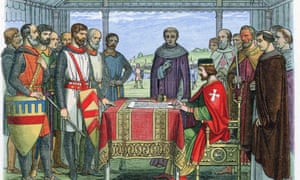
King John signing Magna Carta at Runnymeade 15 June 1215.

This year, 2015, is the 800th anniversary of Magna Carta. It was on 15 June 1215 that King John, in the meadow of Runnymede beside the Thames between Windsor and Staines, sealed (not signed) the document now known as the Magna Carta. Today, jets taking off from London Heathrow airport come up over Runnymede and then often turn to fly down its whole length before vanishing into the distance. Yet it is not difficult to imagine the scene, during those tense days in June 1215, when Magna Carta was being negotiated, the great pavilion of the king, like a circus top, towering over the smaller tents of barons and knights stretching out across the meadow........
https://www.theguardian.com/books/2015/jan/02/magna-carta-800th-anniversary-relevance-david-carpenter
The Highest and Lowest Paid Jobs in America, in One Really, Really Ridiculously Long Chart
https://mic.com/articles/92023/the-highest-and-lowest-paid-jobs-in-america-in-one-really-really-ridiculously-long-chart#.UbJetmjMn
the, highest, and, lowest, paid, jobs, in, america,, in, one, really,, really, ridiculously, long, chart,


Politics as a Vocation 
Max Weber

THIS lecture, which I give at your request, will necessarily disappoint you in a number of ways. You will naturally expect me to take a position on actual problems of the day. But that will be the case only in a purely formal way and toward the end, when I shall raise certain questions concerning the significance of political action in the whole way of life. In today's lecture, all questions that refer to what policy and what content one should give one's political activity must be eliminated. For such questions have nothing to do with the general question of what politics as a vocation means and what it can mean. Now to our subject matter.

What do we understand by politics? The concept is extremely broad and comprises any kind of independent leadership in action. One speaks of the currency policy of the banks, of the discounting policy of the Reichsbank, of the strike policy of a trade union; one may speak of the educational policy of a municipality or a township, of the policy of the president of a voluntary association, and, finally, even of the policy of a prudent wife who seeks to guide her husband. Tonight, our reflections are, of course, not based upon such a broad concept. We wish to understand by politics only the leadership, or the influencing of the leadership, of a political association, hence today, of a state.

But what is a 'political' association from the sociological point of view? What is a 'state'? Sociologically, the state cannot be defined in terms of its ends. There is scarcely any task that some political association has not taken in hand, and there is no task that one could say has always been exclusive and peculiar to those associations which are designated as political ones: today the state, or historically, those associations which have been the predecessors of the modern state. Ultimately, one can define the modern state sociologically only in terms of the specific means peculiar to it, as to every political association, namely, the use of physical force...........
http://anthropos-lab.net/wp/wp-content/uploads/2011/12/Weber-Politics-as-a-Vocation.pdf
Capital is Back:
 Wealth-Income Ratios in Rich Countries 1700-2010 

Thomas Piketty Paris School of Economics 
Gabriel Zucman Paris School of Economics 
July 26, 2013

Abstract
How do aggregate wealth-to-income ratios evolve in the long run and why? We address this question using 1970-2010 national balance sheets recently compiled in the top eight developed economies. For the U.S., U.K., Germany, and France, we are able to extend our analysis as far back as 1700. We find in every country a gradual rise of wealth-income ratios in recent decades, from about 200-300% in 1970 to 400-600% in 2010. In e↵ect, today’s ratios appear to be returning to the high values observed in Europe in the eighteenth and nineteenth centuries (600-700%). This can be explained by a long run asset price recovery (itself driven by changes in capital policies since the world wars) and by the slowdown of productivity and population growth, in line with the ! = s/g Harrod-Domar-Solow formula. That is, for a given net saving rate s = 10%, the long run wealth-income ratio ! is about 300% if g = 3% and 600% if g = 1.5%. Our results have important implications for capital taxation and regulation and shed new light on the changing nature of wealth, the shape of the production function, and the rise of capital shares.
http://piketty.pse.ens.fr/files/PikettyZucman2013WP.pdf

Capitalism’s Gravediggers

How we define capitalism and think about its development shapes how we struggle to transcend it.
by Ellen Meiksins Wood
Capitalism” was for a while a forbidden word, at least in mainstream politics and media, which treated it as a left-wing pejorative. What we got instead were “private enterprise,” the “free market,” and so on. The word is now back in more common usage, but its meaning tends to be a bit vague.
Pressed for a definition of capitalism, most people would make some reference to markets, trade, and commerce. Any society with well-developed commercial activity, particularly (but not only?) where trade and industry are privately owned, would count.
Some people insist on defining the term more precisely. I’m one of them — and we’ve been criticized for offering too precise a definition (more on that later). But it seems to me there are advantages to being clear about what truly distinguishes the capitalist system from any other social form — at least if we want to understand why it operates the way it does, whether in (relatively) good times or in bad.

Defining Capitalism.......

Society of the Spectacle

Guy Debord 1967

Written: 1967;
Translation: Black & Red, 1977;
Transcription/HTML Markup: Greg Adargo.

1.
In societies where modern conditions of production prevail, all of life presents itself as an immense accumulation of spectacles. Everything that was directly lived has moved away into a representation.
2.
The images detached from every aspect of life fuse in a common stream in which the unity of this life can no longer be reestablished. Reality considered partially unfolds, in its own general unity, as a pseudo-world apart, an object of mere contemplation. The specialization of images of the world is completed in the world of the autonomous image, where the liar has lied to himself. The spectacle in general, as the concrete inversion of life, is the autonomous movement of the non-living.

3.
The spectacle presents itself simultaneously as all of society, as part of society, and as instrument of unification. As a part of society it is specifically the sector which concentrates all gazing and all consciousness. Due to the very fact that this sector is separate, it is the common ground of the deceived gaze and of false consciousness, and the unification it achieves is nothing but an official language of generalized separation..........
https://www.marxists.org/reference/archive/debord/society.htm

Reading Marx’s Capital Volume 2 with David Harvey
A close reading of the text of Karl Marx’s Capital Volume 2 (plus parts of Volume 3) in 12 video lectures by Professor David Harvey.
These lectures were the inspiration for the book: A Companion to Marx’s Capital Volume 2 published by Verso in 2013.
Reading Capital
Reading Marx’s Capital Volume I with David Harvey
A close reading of the text of Karl Marx’s Capital Volume I in 13 video lectures by Professor David Harvey. Links to the complete course:
http://davidharvey.org/reading-capital/
Capital 
A Critique of Political Economy

Volume I Book One: 
The Process of Production of Capital

First published: in German in 1867, English edition first published in 1887;
Source: First English edition of 1887 (4th German edition changes included as indicated) with some modernisation of spelling;
Publisher: Progress Publishers, Moscow, USSR;
Translated: Samuel Moore and Edward Aveling, edited by Frederick Engels; Transcribed: Zodiac, Hinrich Kuhls, Allan Thurrott, Bill McDorman, Bert Schultz and Martha Gimenez (1995-1996); Proofed: by Andy Blunden and Chris Clayton (2008), Mark Harris (2010), Dave Allinson (2015).

https://www.marxists.org/archive/marx/works/download/pdf/Capital-Volume-I.pdf

..........................................................................................................................................
Capital 
A Critique of Political Economy 

Volume II Book One
The Process of   Circulation of Capital 
Edited by Friedrich Engels

Written: in draft by Marx 1863-1878,
edited for publication by Engels; First published: in German in 1885, authoritative revised edition in 1893;
Source: First English edition of 1907; Published: Progress Publishers, Moscow, 1956, USSR; Transcribed: by Doug Hockin and Marxists Internet Archive volunteers in the Philippines in 1997; Proofed: and corrected by Andy Blunden and Chris Clayton (2008), Mark Harris (2010).

https://www.marxists.org/archive/marx/works/download/pdf/Capital-Volume-II.pdf

......................................................................................................................................
Karl Marx CAPITAL 

Vol. III 
THE PROCESS OF CAPITALIST PRODUCTION AS A WHOLE

Written: Karl Marx, 1863-1883, 
edited by Friedrick Engels and completed by him eleven years after Marx's death. 
Source: Institute of Marxism-Leninism, USSR, 1959 Publisher: International Publishers, NY, [n.d.] First Published: 1894 Translated: On-Line Version: Marx.org 1996, Marxists.org 1999 Transcribed: Transcribed for the Internet in 1996 by Hinrich Kuhls and Zodiac, and by Tim Delaney and M. Griffin in 1999. HTML Markup: Zodiac 1996, Tim Delaney and M. Griffin in 1999

https://www.marxists.org/archive/marx/works/download/Marx_Capital_Vol_3.pdf

An Anarchist Critique of Democracy

Introduction

We decided to compile this critique of democracy because we recognize an inherent tension between democracy and the freedom of individuals to create their own lives as they see fit. Some of the problems we find with democracy have been acknowledged by defenders of democracy as well, but have only led to the development of amended types of democracies (as various thinkers tried to prune the concept into an acceptable shape). By contrast, our analysis has led us to abandon the concept all together, because we find some fundamental faults with the idea itself that can not be reconciled by new modifications or reforms. Our critique is of democracy in all its various forms, whether representative or direct. We are not echoing confused cries for more democracy, we are calling for its entire abolition.
In this show, we’ll investigate the concept of alienation and how democracy promotes it. We’ll question the logic of decontextualized decision making, the reduction of ideas to opinions, and the near-universal acceptance of “majority rule.” We’ll also go over a few immanent critiques of democracy involving demagoguery, lobbying, and corruption that are more readily accepted even by defenders of democracy, and then we’ll talk about why democracy is so good at maintaining and reproducing itself................

Notes on Anarchism

Noam Chomsky

In Daniel Guérin, Anarchism: From Theory to Practice, 1970

A French writer, sympathetic to anarchism, wrote in the 1890s that “anarchism has a broad back, like paper it endures anything” — including, he noted those whose acts are such that “a mortal enemy of anarchism could not have done better.”1 There have been many styles of thought and action that have been referred to as “anarchist.” It would be hopeless to try to encompass all of these conflicting tendencies in some general theory or ideology. And even if we proceed to extract from the history of libertarian thought a living, evolving tradition, as Daniel Guérin does inAnarchism, it remains difficult to formulate its doctrines as a specific and determinate theory of society and social change. The anarchist historian Rudolph Rocker, who presents a systematic conception of the development of anarchist thought towards anarchosyndicalism, along lines that bear comparison to Guérins work, puts the matter well when he writes that anarchism is not


"a fixed, self-enclosed social system but rather a definite trend in the historic development of mankind, which, in contrast with the intellectual guardianship of all clerical and governmental institutions, strives for the free unhindered unfolding of all the individual and social forces in life. Even freedom is only a relative, not an absolute concept, since it tends constantly to become broader and to affect wider circles in more manifold ways. For the anarchist, freedom is not an abstract philosophical concept, but the vital concrete possibility for every human being to bring to full development all the powers, capacities, and talents with which nature has endowed him, and turn them to social account. The less this natural development of man is influenced by ecclesiastical or political guardianship, the more efficient and harmonious will human personality become, the more will it become the measure of the intellectual culture of the society in which it has grown.2" .............
https://chomsky.info/1970____/
https://theanarchistlibrary.org/library/noam-chomsky-notes-on-anarchism.a4.pdf
Noam Chomsky on Anarchism, Marxism & Hope for the Future
Noam Chomsky is widely known for his critique of U.S foreign policy, and for his work as a linguist. Less well known is his ongoing support for libertarian socialist objectives. In a special interview done for Red and Black Revolution, Chomsky gives his views on anarchism and marxism, and the prospects for socialism now. The interview was conducted in May 1995 by Kevin Doyle.

RBR: First off, Noam, for quite a time now you've been an advocate for the anarchist idea. Many people are familiar with the introduction you wrote in 1970 to Daniel Guerin's Anarchism: From Theory to Practice, but more recently, for instance in the film Manufacturing Dissent, you took the opportunity to highlight again the potential of anarchism and the anarchist idea. What is it that attracts you to anarchism?

CHOMSKY: I was attracted to anarchism as a young teenager, as soon as I began to think about the world beyond a pretty narrow range, and haven't seen much reason to revise those early attitudes since. I think it only makes sense to seek out and identify structures of authority, hierarchy, and domination in every aspect of life, and to challenge them; unless a justification for them can be given, they are illegitimate, and should be dismantled, to increase the scope of human freedom. That includes political power, ownership and management, relations among men and women, parents and children, our control over the fate of future generations (the basic moral imperative behind the environmental movement, in my view), and much else. Naturally this means a challenge to the huge institutions of coercion and control: the state, the unaccountable private tyrannies that control most of the domestic and international economy, and so on. But not only these. That is what I have always understood to be the essence of anarchism: the conviction that the burden of proof has to be placed on authority, and that it should be dismantled if that burden cannot be met. Sometimes the burden can be met. If I'm taking a walk with my grandchildren and they dart out into a busy street, I will use not only authority but also physical coercion to stop them. The act should be challenged, but I think it can readily meet the challenge. And there are other cases; life is a complex affair, we understand very little about humans and society, and grand pronouncements are generally more a source of harm than of benefit. But the perspective is a valid one, I think, and can lead us quite a long way.

Beyond such generalities, we begin to look at cases, which is where the questions of human interest and concern arise..........
http://flag.blackened.net/revolt/rbr/noamrbr2.html

https://theanarchistlibrary.org/library/daniel-guerin-anarchism-from-theory-to-practice.a4.pdf