Sunday, July 17, 2016


https://www.youtube.com/watch?v=tnXjdv_GM9g
http://deadspin.com/the-story-behind-bob-beamons-miracle-jump-and-the-only-1736766124
This has happened in the 1968 Olympics in Mexico City
 ................ Officials had installed an electronic measuring device that ran 
on a rail alongside the pit. The judges moved the optical sight to the point 
where Beamon landed — out, farther, out some more – until it fell off the 
far end of the rail. They hurried off to find a measuring tape.
Some 20 minutes passed as the officials checked and double-checked the 
distance. Finally, three numbers were posted on the scoreboard: 8.90.
It was the distance of the jump in meters, and Beamon did not realize 
what that was in feet and inches. Boston informed him it was beyond 
29 feet–and Beamon collapsed onto the track..."


Inline image 1

Great interviews of the 20th century


David Frost's interview with Richard Nixon broadcast in May 1977
https://www.theguardian.com/theguardian/2007/sep/07/greatinterviews1


Interviews - the PARIS REVIEW

William Faulkner, The Art of Fiction No. 12


Harold Pinter, The Art of Theater No. 3

Philip Roth, The Art of Fiction No. 84


Hilary Mantel, Art of Fiction No. 226

Alice Munro, The Art of Fiction No. 137

Joseph Heller, The Art of Fiction No. 51


Gore Vidal, The Art of Fiction No. 50


Interviews

Haruki Murakami, The Art of Fiction No. 182


Haruki Murakami is not only arguably the most experimental Japanese novelist to have been translated into English, he is also the most popular, with sales in the millions worldwide. His greatest novels inhabit the liminal zone between realism and fable, whodunit and science fiction: Hard-Boiled Wonderland and the End of the World, for example, features a protagonist who is literally of two minds, and The Wind-Up Bird Chronicle, perhaps his best-known work outside of Japan, begins prosaically—as a man’s search for his missing wife—then quietly mutates into the strangest hybrid narrative since Laurence Sterne’s Tristram Shandy. Murakami’s world is an allegorical one, constructed of familiar symbols—an empty well, an underground city—but the meaning of those symbols remains hermetic to the last. His debt to popular culture (and American pop culture, in particular) notwithstanding, it could be argued that no author’s body of work has ever been more private.
http://www.theparisreview.org/interviews/2/the-art-of-fiction-no-182-haruki-murakami

Saturday, July 16, 2016


Magna Carta – 800 years on

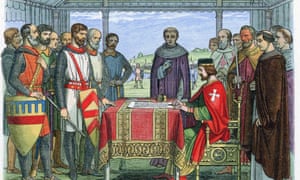
King John signing Magna Carta at Runnymeade 15 June 1215.

This year, 2015, is the 800th anniversary of Magna Carta. It was on 15 June 1215 that King John, in the meadow of Runnymede beside the Thames between Windsor and Staines, sealed (not signed) the document now known as the Magna Carta. Today, jets taking off from London Heathrow airport come up over Runnymede and then often turn to fly down its whole length before vanishing into the distance. Yet it is not difficult to imagine the scene, during those tense days in June 1215, when Magna Carta was being negotiated, the great pavilion of the king, like a circus top, towering over the smaller tents of barons and knights stretching out across the meadow........
https://www.theguardian.com/books/2015/jan/02/magna-carta-800th-anniversary-relevance-david-carpenter
The Highest and Lowest Paid Jobs in America, in One Really, Really Ridiculously Long Chart
https://mic.com/articles/92023/the-highest-and-lowest-paid-jobs-in-america-in-one-really-really-ridiculously-long-chart#.UbJetmjMn
the, highest, and, lowest, paid, jobs, in, america,, in, one, really,, really, ridiculously, long, chart,


Politics as a Vocation 
Max Weber

THIS lecture, which I give at your request, will necessarily disappoint you in a number of ways. You will naturally expect me to take a position on actual problems of the day. But that will be the case only in a purely formal way and toward the end, when I shall raise certain questions concerning the significance of political action in the whole way of life. In today's lecture, all questions that refer to what policy and what content one should give one's political activity must be eliminated. For such questions have nothing to do with the general question of what politics as a vocation means and what it can mean. Now to our subject matter.

What do we understand by politics? The concept is extremely broad and comprises any kind of independent leadership in action. One speaks of the currency policy of the banks, of the discounting policy of the Reichsbank, of the strike policy of a trade union; one may speak of the educational policy of a municipality or a township, of the policy of the president of a voluntary association, and, finally, even of the policy of a prudent wife who seeks to guide her husband. Tonight, our reflections are, of course, not based upon such a broad concept. We wish to understand by politics only the leadership, or the influencing of the leadership, of a political association, hence today, of a state.

But what is a 'political' association from the sociological point of view? What is a 'state'? Sociologically, the state cannot be defined in terms of its ends. There is scarcely any task that some political association has not taken in hand, and there is no task that one could say has always been exclusive and peculiar to those associations which are designated as political ones: today the state, or historically, those associations which have been the predecessors of the modern state. Ultimately, one can define the modern state sociologically only in terms of the specific means peculiar to it, as to every political association, namely, the use of physical force...........
http://anthropos-lab.net/wp/wp-content/uploads/2011/12/Weber-Politics-as-a-Vocation.pdf